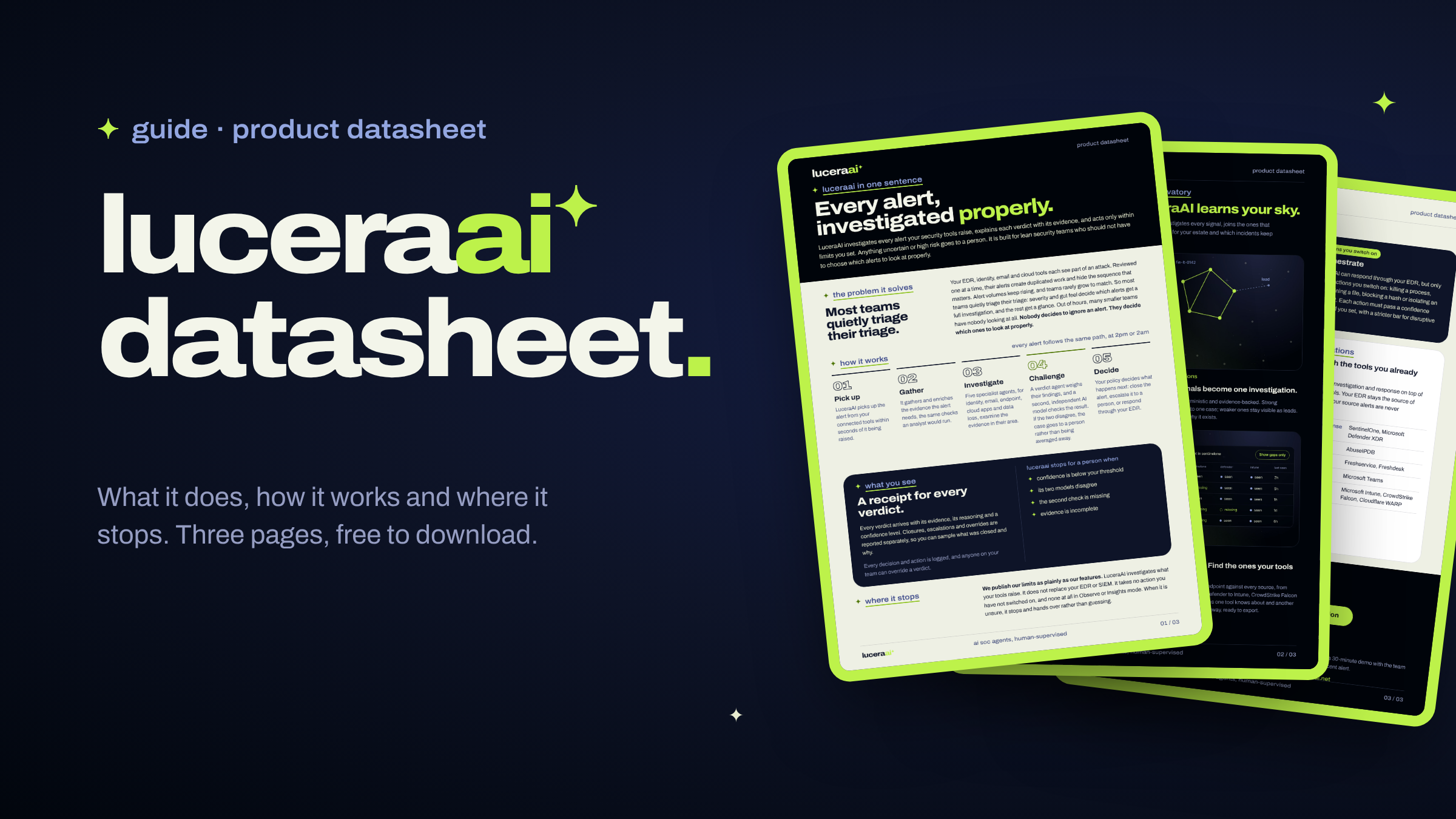
Download the comparison guide (PDF, 3 pages) →
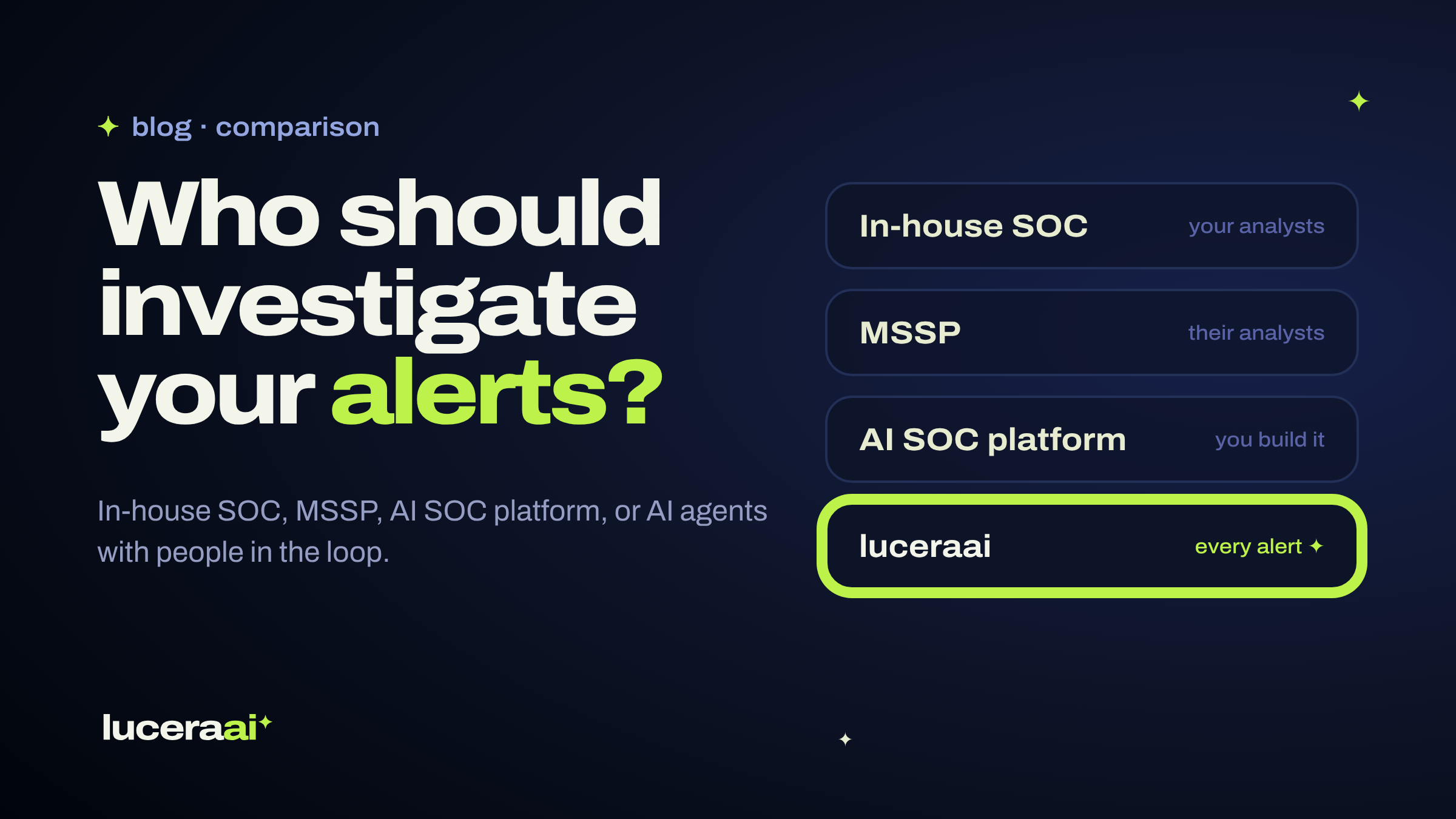
Your EDR raises alerts around the clock. Someone, or something, has to decide what each one means. For most organisations that comes down to four options: build your own SOC, hire an MSSP, buy an AI SOC platform, or use AI SOC agents with people supervising them.
None of them is right for everyone. The useful question is not which is best, but which fits your team, your budget and how much you need to see behind each decision.
The four options
An in-house SOC
Your own analysts, tools and processes. Nobody knows your business better, and you keep full control. The catch is cost and continuity: covering 24/7 means hiring, training and keeping a shift team, and alerts still queue when people are stretched.
An MSSP
A provider’s analysts watch your alerts round the clock, usually across many customers at once. You get people on shift without having to hire them. In return, the provider makes the calls, and how much of their reasoning you see depends on the provider and the contract.
An AI SOC platform
A security automation platform with case management and AI agents for investigation and response. These platforms can move quickly once they are set up, and suit enterprise SOCs with automation engineers. Expect to build and tune the workflows yourself, and to decide how much it does without a person.
AI SOC agents, human-supervised
This is where LuceraAI sits. A council of specialist AI agents investigates every alert your EDR raises. Two independent models from different providers must agree on each verdict, a devil’s advocate argues it is wrong, and anything uncertain or high risk goes to a person. Every verdict comes with a receipt: its evidence, its reasoning and a confidence level.
What separates them
- Coverage. Does every alert get a full investigation, including at 2am, or only the ones someone has time for?
- Explanation. Can you see the evidence and reasoning behind each closed alert, or only a ticket summary?
- People in the loop. What happens when the system or the analyst is unsure? Who makes that call?
- Control. Which actions can happen on your estate without your approval?
- Effort. Who builds and maintains the playbooks and automations?
- Data. Where is your data held, and is it used to train AI models?
The right option is the one whose decisions you can check.
When each option makes sense
- An in-house SOC when you have the budget and hiring pipeline for round-the-clock shifts, and need analysts who know your business intimately.
- An MSSP when you want monitoring fully outsourced and are comfortable with the provider deciding for you. Ask to see how each closed alert was decided.
- An AI SOC platform when you have an enterprise SOC, automation engineers and time to build the workflows.
- LuceraAI when your EDR raises more alerts than your team can investigate, you can’t staff a 24/7 SOC, and you want every alert investigated with evidence you can check before anything acts on your estate.
These options also combine. LuceraAI can sit alongside an in-house team, gathering the evidence so analysts start every case with the work already done.
Want the side-by-side table and the questions to ask any provider? Download the full comparison guide (PDF).
Test it on your own alerts
The fairest comparison is your own data. Connect your EDR with read-only access and run LuceraAI in Observe mode for two weeks. Nothing acts on your estate. At the end you get the results against your own baseline, with method notes and a plain list of anything we could not measure.
Run an evaluation or book a 30-minute demo, and bring a recent alert.